
Why We Keep Being Recognized as a Startup to Watch
News – 13/01/26
Over the past year, we’ve been included in multiple independent analyses highlighting startups shaping the future of computing, including investor platforms, national business media, global AI, and supercomputing reports.
These recognitions span different audiences and geographies, yet they consistently point to the same underlying challenge: modern workloads demand scalable parallelism that today’s CPU architectures struggle to deliver efficiently.
At the center of these discussions is the Parallel Processing Unit (Flow PPU), our CPU-integrated approach to general-purpose parallel execution.
This article explains why we keep appearing in these conversations, using the words of those who identified the trend.
The limits of conventional CPU scaling
Cloud infrastructure, AI inference, and data-intensive applications rely heavily on parallel execution. At the same time, server CPUs continue to scale performance primarily by replicating CPU cores originally designed for sequential workloads.
As core counts increase, this approach runs into structural limitations:
- Growing thread management overhead
- Memory bottlenecks and cache contention
- Increasing synchronization costs
- Diminishing scalability beyond a limited number of cores
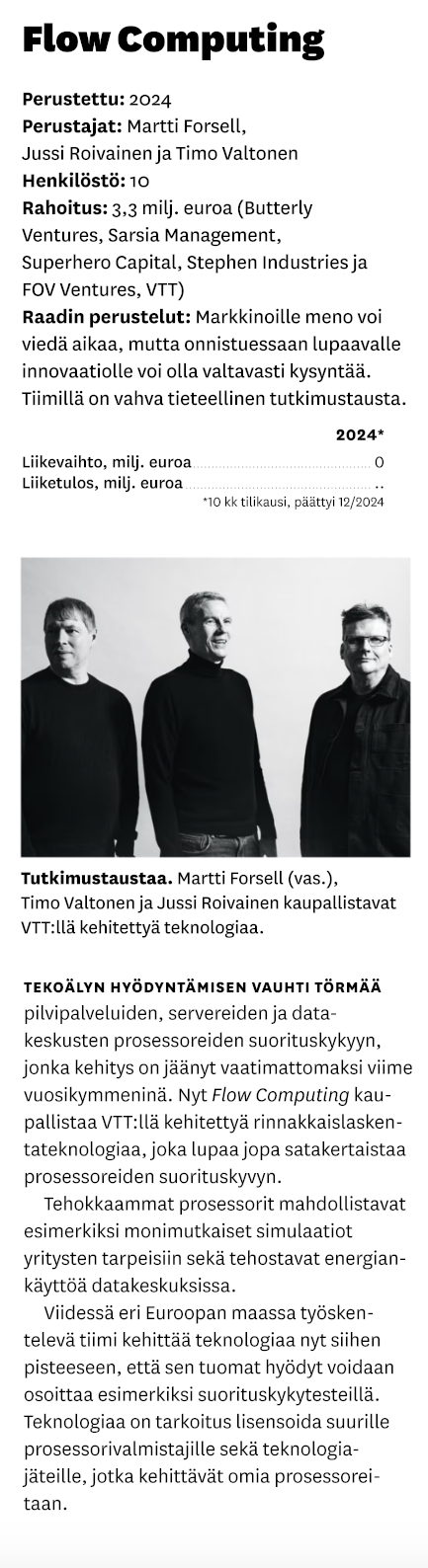
This growing mismatch was highlighted by Talouselämä, which described the situation clearly:
“The speed of AI adoption is colliding with the performance limitations of processors in cloud services, servers, and data centers, which have seen only modest improvements in recent decades.” -Talouselämä, 10 Most Interesting Startups
Rather than a lack of compute, the issue is a lack of scalable parallel execution capabilities inside the CPU chip itself.
What we’re building
We’re developing Flow PPU, a general-purpose parallel co-processor that integrates directly into a CPU chip.
Flow PPU is a licensable IP block and is designed to work alongside the CPU, not replace it. Together, the CPU and Flow PPU divide work based on execution characteristics:
- Serial parts are executed on the CPU
- Parallel parts are executed on Flow PPU
This approach enables scalable parallel performance while maintaining compatibility with existing software.
Flow PPU is instruction-set independent and can be applied to Arm, x86, RISC-V, and Power architectures. It also comes with a step-by-step migration path, so software development doesn’t need to start from scratch.
Talouselämä summarized this succinctly:
“Now, Flow Computing is commercializing parallel computing technology developed at VTT, which promises to increase processor performance.” -Talouselämä, 10 Most Interesting Startups
Thick Control Flow and scalable parallel execution
At the architectural core of Flow PPU is a model called Thick Control Flow (TCF).
Traditional multicore CPUs replicate execution machinery without providing sufficient intercommunication capabilities. As parallelism increases, the communication overhead starts to limit scalability.
TCF introduces a different architectural approach for managing parallel data and control flows, and thus intercommunication. By reducing synchronization overhead and enabling efficient handling of challenging memory access patterns, Flow PPU scales parallel execution more efficiently and predictably than conventional multicore designs.
In practice, this enables:
- Linear scalability for parallel workloads
- Simplified parallel execution and thread management
- Lower synchronization overhead
- High memory throughput without coherency bottlenecks
The goal is to make parallel execution more efficient, not force developers to manually orchestrate data partitioning and execution of parallel software components.
Where Flow PPU is relevant
Because Flow PPU targets general-purpose parallelism, it applies across multiple environments:
Server & Cloud AI CPUs
Scalable throughput for cloud, HPC, and AI workloads, accelerating preprocessing, inference, scientific compute, and large-scale services
Industrial & Embedded AI CPUs
Deterministic, low-latency performance for robotics, autonomous systems, edge inference, defense, and real-time industrial compute.
Consumer & Edge AI CPUs
High-performance, energy-efficient acceleration for mobile AI, edge inference, and next-generation consumer devices.
This breadth explains why we appear in analyses spanning AI hardware infrastructure, cloud computing, and next-generation processors.
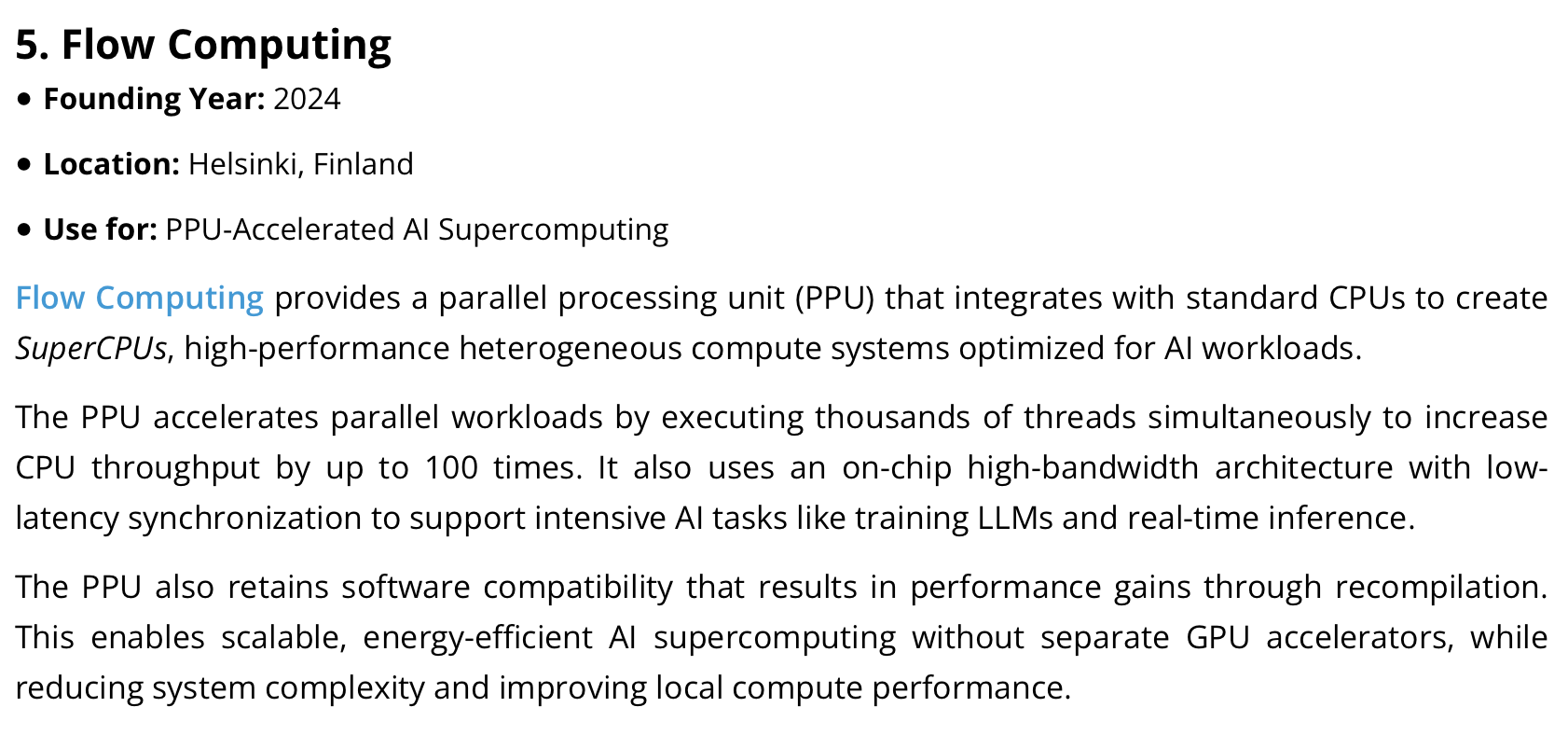
In its global AI supercomputing report, StartUs Insights described us as:
“Flow PPU also retains software compatibility that results in performance gains through recompilation. This enables scalable, energy-efficient AI supercomputing without separate GPU accelerators, while reducing system complexity and improving local compute performance..”- StartUs Insights, 10 AI Supercomputing Startups to Watch in 2025
Independent signals, same conclusion
Our inclusion in investor and ecosystem shortlists reflects the same architectural pressure point.
Following the Vestbee Winter Pitch, Vestbee listed Flow among its 100 must-follow startups, highlighting companies building “smart, practical solutions across AI, fintech, climate, health, and deep tech.”
At the national ecosystem level, EU-Startups included Flow in its overview of promising Finnish startups, noting the company’s focus on CPU performance, AI, and parallel computing.
These recognitions are not coordinated. They are independent responses to the same shift:
The growing mismatch between modern parallel workloads, increasing demand for computing performance and limitations of existing CPU design assumptions.
A platform for parallel computing
Flow PPU is not intended as a patch to existing architectures. It is a platform for evolving parallel computing in a way that is scalable, efficient, and compatible with current software ecosystems.
Developers retain control over which parts of their software run on the CPU and which are offloaded to Flow PPU, preserving existing investments while unlocking significant performance gains where parallelism matters most.
As parallel workloads continue to grow, architectural approaches that reduce complexity, rather than add layers, are likely to play an increasingly important role.
That is the context in which Flow Computing continues to be recognized.
Contact us at info@flow-computing.com to learn more about the PPU and our approach to scalable computing.